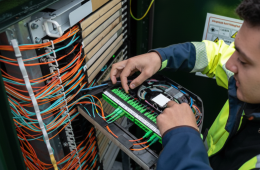


Fiber Infrastructure Plays a Key Role in Turkey’s 5G Journey
The countdown for Turkey’s 5G tender has officially begun. Industry experts emphasize that for 5G to reach its full capacity, fiber infrastructure is of critical importance. The high speeds, low latency, and seamless connectivity promised by 5G technology are not made possible by radio access systems alone; they require a robust, widespread, and modern fiber backbone operating in the background.
Fiber: The Power Behind 5G
5G is a next-generation mobile communication technology capable of reaching theoretical speeds of 10 Gbps while providing millisecond-level low latency. however, to deliver these speeds to the end-user, base stations must be heavily backhauled by fiber. Today, the common denominator among countries that have successfully transitioned to 5G is that 70% to 90% of their base stations are directly connected to fiber networks. While Turkey has made significant progress through recent investments, there remains a vital need for broader fiber expansion.
Data Traffic Will Increase Exponentially
With the implementation of 5G, several major shifts are expected:
The number of IoT devices will reach into the billions.
Autonomous vehicle technologies will become widespread.
Industry 4.0 processes will accelerate.
Cloud gaming and VR/AR applications will increase.
Intensive data flow in major cities will accelerate even further.
Fiber optic cabling is the only reliable infrastructure capable of carrying this massive increase in data traffic.
A Strategic Period for Operators
Following the 5G tender, operators will enter a race to expand coverage and enhance service quality. During this period, investments in fiber infrastructure will provide both a competitive advantage and a reduction in long-term operational costs. Specifically, the acceleration of FTTH (Fiber-to-the-Home) and FTTB (Fiber-to-the-Building) investments will make gigabit internet for homes, low-latency connections for businesses, and smart city applications far more accessible.
New Opportunities for Local Manufacturers
The 2025–2026 period is also considered to hold significant growth potential for local companies manufacturing fiber Fiber Fiber Fiber Fiber Fiber Distribution Boxes, splice closures, joints, cabinets, and optical cables. Opting for local production for the outdoor equipment used in 5G projects provides both a cost advantage and ensures continuity within the supply chain.
Turkey’s Digital Future Will Be Shaped by Fiber
For the potential offered by 5G to be fully realized, the construction of a nationwide, powerful fiber infrastructure is essential. Experts suggest that if fiber investments continue to accelerate, Turkey will gain a major advantage in becoming a regional technology hub.
In short: 5G may be the technology of the future, but the road to that future is paved entirely with fiber.